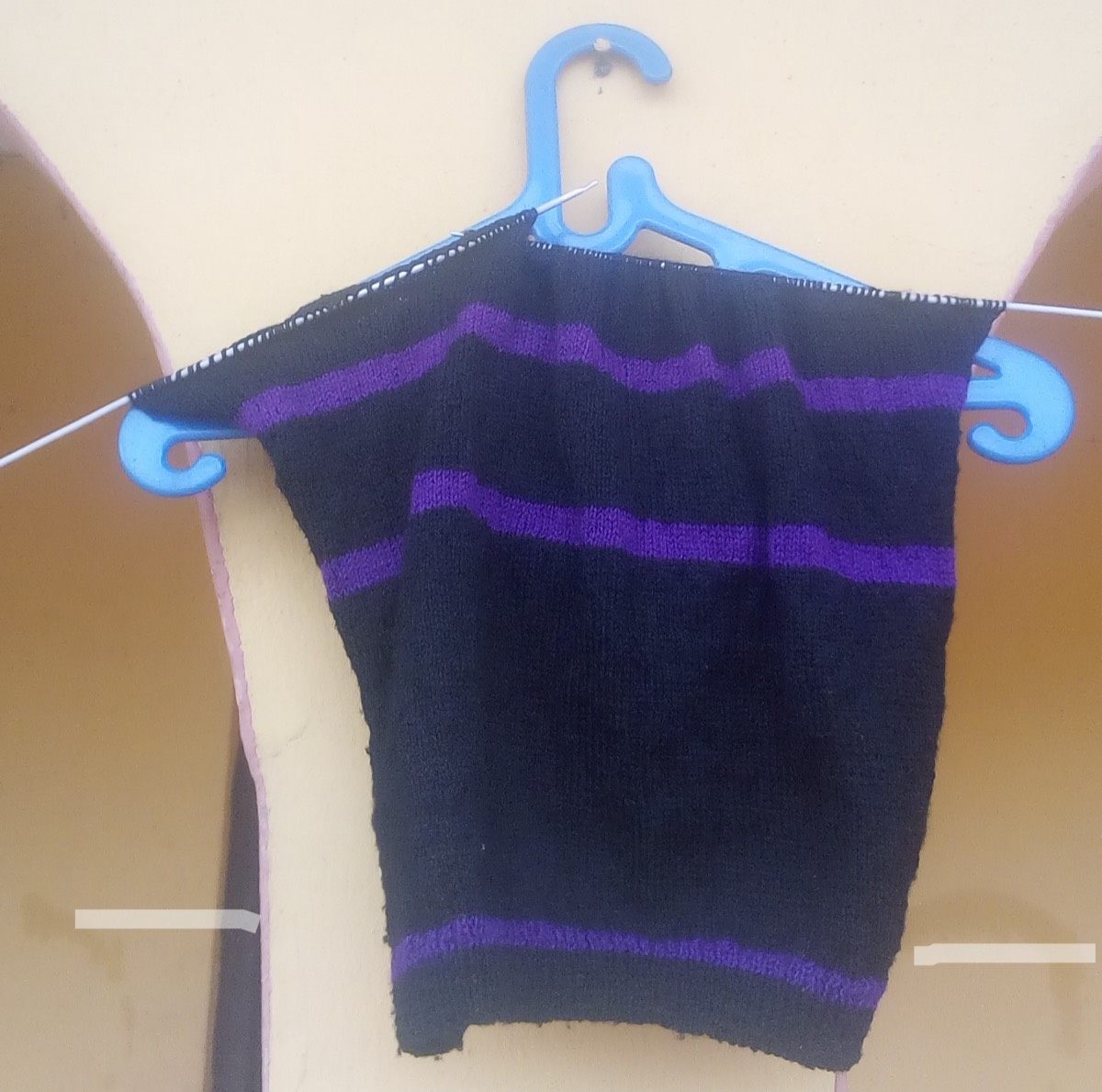

A steek is a bridge of extra stitches that lets you knit a cardigan, or a sweater with cut armholes, entirely in the round. You knit a tube, reinforce the bridge, cut it open, and pick up the bands along the cut edge.
It sounds alarming the first time. The technique is reliable when the yarn and the reinforcement suit it, and the extra stitches are planned before the first round.
Plan the steek
- Add 5–7 extra stitches at the centre front (or at each armhole) where the cut will be.
- Mark the centre stitch. The cut runs up the middle of the steek.
- Work the steek in a contrast colour if the pattern allows; it makes the bridge easy to see.
- Keep the steek stitches in stockinette even if the body is patterned; they will be hidden or cut away.
The body stitch count excludes the steek. A 200-stitch body with a 7-stitch steek is cast on as 207 stitches, with the steek at the centre front.
Choose a suitable yarn
Traditional non-superwash wool is the easiest yarn to steek: the fibres grip each other and the cut edge holds. Superwash wool, cotton, silk and slippery blends can unravel; they need machine reinforcement or a sewn seam before cutting.
Always test the technique on a swatch. Knit a small tube with a steek, reinforce and cut it, then pick up a band. If the swatch holds, the garment will.
Reinforce before cutting
- Machine sewing: two parallel lines of small stitches on either side of the cut line.
- Crochet reinforcement: a slip-stitch or single-crochet chain down each side of the cut.
- Hand sewing: a backstitch or running stitch, close and even.
Reinforce both sides of the centre line. The cut then runs between the two reinforced columns.
Cut and pick up
Cut carefully up the centre, keeping the scissors between the reinforced lines. Do not cut the reinforcement itself. Once the edge is open, pick up the band along the cut: about three stitches for every four rows, adjusted to the rib multiple.
The cut edge will be hidden inside the band. If the band is knitted double and folded, the raw edge is enclosed; if it is a single band, the edge can be covered with a ribbon or a facing.
A worked example
Body 200 stitches, steek 7 stitches, centre front. Knit the tube to the armholes. Reinforce both sides of the centre stitch, cut, and pick up 3 stitches per 4 rows along the front edge. For a 60 cm front edge, that is about 135 stitches, rounded to a multiple of 4 for a 2×2 rib.
Work the band to the desired depth, make the buttonholes at the marked positions, and bind off in pattern. The steek is now inside the band and invisible from the outside.
Armhole steeks
Steeks are also used at the armholes when a sweater is knitted in the round to the shoulders. Add the same 5–7 stitches at each armhole, reinforce both sides, and cut after the body is finished. Pick up the sleeve stitches around the opening; the steek edge is hidden inside the seam.
Test the armhole steek on a swatch before cutting the body. The curve of the armhole is less forgiving than a straight front opening.
Limits
Steeking is a construction choice, not a repair. It works best with grippy wool and a planned steek; it is risky with slippery yarns and unplanned cuts. If you are unsure, knit the cardigan flat or use a pattern designed for steeks.
Swatch the colourwork in the round and check the stranded gauge before cutting the steeks.