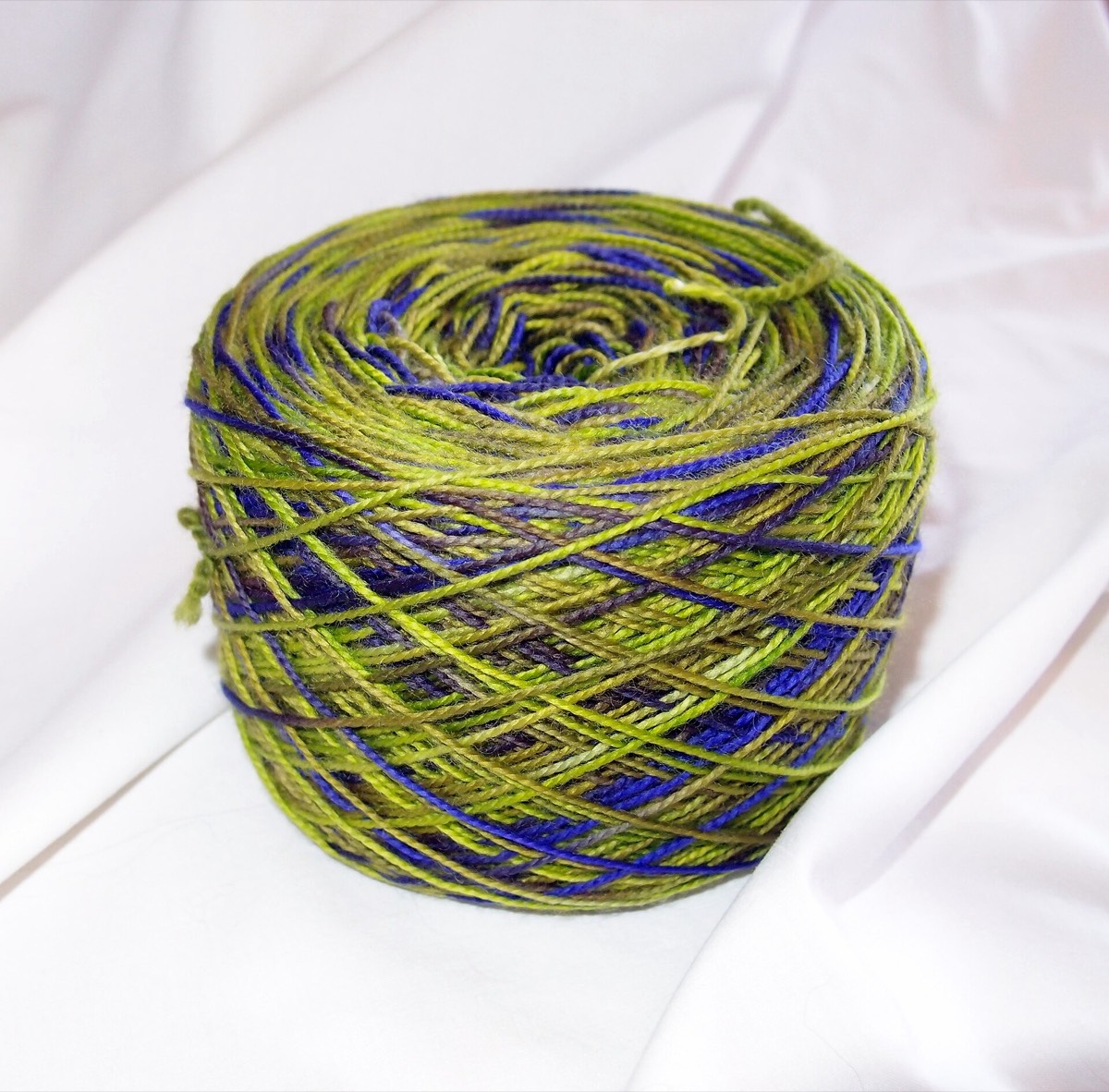

Substituting yarn in a pattern is easy when the replacement can reach the same gauge and behaves like the original. It becomes a re-draft when the gauge, fibre or structure is far away. The goal is to stay in the first category.
The order of checks: gauge band, length, fibre, structure, then swatch. If the swatch cannot reach the pattern's gauge without a fabric you dislike, stop and choose another yarn.
1. Start with the gauge band
Match the CYC weight category where possible. A DK pattern expects a DK yarn; a worsted pattern expects worsted. Crossing a weight boundary is possible, but it changes the fabric and the stitch counts, so treat it as a re-draft rather than a substitute.
The pattern's gauge line gives the target: stitches and rows over 10 cm in a specified stitch. Use that as the test.
2. Match the length, not the skein count
Add up the total metres the pattern requires. Divide by the replacement skein length, round up, and add a 10–15% buffer. Do not assume that the same number of skeins will work; put-ups vary.
3. Check the fibre and structure
- Fibre. Wool, cotton, alpaca and acrylic behave differently in drape, memory and blocking.
- Structure. A smooth plied yarn and a haloed singles yarn at the same weight produce different fabric.
- Stitch definition. Cables and lace are more sensitive to structure than plain stockinette.
4. Swatch the actual pattern
Knit a swatch in the pattern's dominant stitch, wash it, and measure. If the gauge is close but the fabric feels wrong, try a different needle size before rejecting the yarn.
If the gauge matches and the fabric is acceptable, the pattern's stitch counts should work. The substitution is now a yarn change, not a re-draft.
A worked example
A pattern calls for 800 m of a yarn with 200 m per 100 g skein. That is four skeins, or 400 g.
The substitute offers 180 m per 100 g. Matching the length means 800 ÷ 180 = 4.44, rounded up to 5 skeins — 900 m and 500 g. Matching the skein count would leave you 80 m short.
Swatch the substitute at the pattern's gauge. If it reaches 20 stitches per 10 cm with a fabric you like, use the pattern as written. If it only reaches 22, you are in re-draft territory.
When it becomes a re-draft
- Gauge far from the pattern. A 10% difference changes the finished size; a 20% difference is a different fabric.
- Different weight category. DK in place of worsted changes the stitch counts and the drape.
- A fibre that changes the shape. Cotton in place of wool in a fitted garment is a design change, not a substitution.
- A structure-sensitive pattern. A haloed yarn in a crisp cable pattern will not look like the sample.
In those cases, choose a pattern written for the new yarn rather than forcing the old one.
Buy the buffer in one dye lot
Substituting often means buying a different brand and dye lot. Buy all the skeins at once, and add 10–15% for swatching and matching. A late extra skein in a different lot is the most common way a substitution gets a visible stripe.
Keep the substitute's label with the project notes. It records the dye lot, put-up and care, which are the numbers you will need if you run short or knit the project again.
Limits
A successful gauge match does not guarantee a successful garment. The fabric may still drape differently, pill differently or block differently. Swatch, wash, and compare with the pattern's sample before committing to the full quantity.
For the fibre-and-yardage step see how to substitute yarn; for the tolerance see when the substitute gauge is close.